Sunday, October 13, 2024

LIS 724: Reflecting on EDU 776/LIS 724 Course

                                               Introduction

    Hello, readers! It may seem surprising, but the class is already reaching its final week. For today’s post, I look back and reflect upon my time enrolled in the course, EDU 776/LIS 724 - Integrating Technology into Programming, Services & Instruction, and I want to share with you my thoughts as I compare my experiences in class from the beginning to the end. When I think back to my relationship with technology before this class, my understanding of technology and relationship to it was rather basic. If anything, I have always been a bit intimidated by new electronic devices and tech developments, preferring to use the devices and apps I already knew and was comfortable with using. I think the LIS 724 pushed me out of my comfort zone in a positive way, teaching how a wide variety of different tools, statistics, technological resources and services which will greatly help me in my future librarian profession after completing my university education. Before, I was hesitant with new technology, but now I feel that this course has encouraged me to be more open-minded with new tech resources in my education, work, and everyday life.

How I felt at the start of the semester. Image source.

                                              My Reflections

    One of the resources I’ve enjoyed learning about and exploring in LIS 724 has been the Wakelet website for a handful of my classroom assignments this past few weeks. Wakelet was not only a great opportunity to be creative and create collections based on subjects which have personal importance to be an individual, but it was very useful as a tool which I can incorporate into my chosen profession as a librarian, helping patrons find reading material, articles and services that I have organized into collections based on subject or specific interests, wants and needs. Another tool I was introduced to in this course that I found very informative and helpful was the subject of digital maps. This allowed me to stop and really consider what websites and apps I use in my everyday life, whether for work or recreational purposes. I think constructing my own digital map for an assignment was beneficial in that I was able to reflect more deeply on not only how much screen-time I use each day, but also how much of that screen-time is dedicated to a split between studying and entertainment. I feel that a digital map is useful in helping find a better balance in much time I spend on my phone and computer. I have also enjoyed working on this very blog each week for class assignments, it has been really exciting to have records of what I have learned and completed each week, being to share my thought s and ideas, exchange messages with my classmates and professor, and to see how much progress I have made as a student over time.  

Image source.

                                                Conclusion

How I feel now at the end of the semester. Image source.

    Although the course was condensed to several weeks, I felt as though I was up to the challenge, despite having some initial nervousness at the start of the semester. I found the LIS 724 course to be very educational about incorporating technology and new resources for both learning and different professional fields, but also simply fun opportunities to express myself as an individual through creative assignments. In spite of my nervousness at the beginning of the semester, I felt that I have become more genuinely curious and bolder in exploring new technological resources and services as a result of this course. When I enter the librarianship profession after university, I am excited to explore and incorporate all that I have learn throughout this course, using my new knowledge to help patrons in the future. I have enjoyed sharing with you my thoughts and discoveries, readers, over these several weeks, I hope my sharing has also helped you discover interesting new tech tools and services too! Thank you for reading my blog!  

Saturday, October 12, 2024

LIS 724: Artificial Intelligence Exploration

                                                  Introduction

Image source.

    Hello, blog readers! Today, I wanted to share with you what I have been studying about artificial intelligence, otherwise commonly known as simply AI, tools and resources. Lately these, it seems as AI services are everywhere we look, where built into our computers and phones in the form of helpful virtual assistants, in our social media apps, advertisement algorithms, our businesses, shopping, deliveries, and entertainment. Although AI seems like a recent trend over the past few months, the truth is AI software is used in a wide variety of resources and services in society, much more often than we may be aware of using in everyday life. At present time, it is becoming increasing more common for AI software to no only be promoted heavily by tech companies, but there is a push for the increased incorporation of AI technology into different areas of society, such as in education at different grade levels and across a wide variety of professional fields, businesses and hobbies.

                                       My Experience with AI

    When reflecting upon my personal experience with AI technology, I would say that my overall engagement and usage of AI has been rather minimal prior to my proactive exploration of AI within this post. I use spellcheck and predictive text in my writing at times, I use Alexa the Android Assistant when asking her questions is easier than typing them out due to my vision disability, and when I use Google Chrome for everyday tasks, Google’s AI-produced answers are the results which automatically appear at the top of the screen, for better or for worse. In my employment and educational histories, neither of my previous employers nor my teachers required AI implemented into my work responsibilities and school tasks. Thus far, I have not had much personal experience overtly using AI, but I am taking the chance this wee to explore the capabilities of AI technology, to proactively familiarize myself with the technology should I need the tools in my future librarian profession and other responsibilities.

                                            Exploring ChatGPT 

    The AI technology I chose to explore for this assignment was ChatGPT, an language processing AI which responds to user prompts with detailed written essays and conversations made in order to mimic human typing. I selected this particular AI as I am a university student, it is one that is commonly utilized by other students for creative writing prompts and essay summaries, either to be incorporated into classroom work or forbidden for use by teachers. I felt it was worth exploring ChatGPT in order to better understand its appeal and to have a basic understanding of the AI’s features in-case I am asked to use the technology in my future workplace as part of my responsibilities. I entered a few prompts into ChatGPT, such as asking it to ne about historical figures, such as Mary Shelley, to tell me facts about animals, such as about dogs, and to create a story based on a few general word suggestions for prompts. I have to say found it impressive how extensive and detailed could make its replies from only a few short words entered.

Image source: Personal Photos of Lizzy Prain, Created Via ChatGPT.

Image source: Personal Photos of Lizzy Prain, Created Via ChatGPT.

Image source: Personal Photos of Lizzy Prain, Created Via ChatGPT.

                                                             Conclusion

Image source.

    After examining the features of the site, I can understand its popularity with others, the prompts allow for help with generating creative writing prompts, organizing essay thoughts, and sparking innovation for site users. I found the AI to have user-friendly functions and interface, and its incredible how quickly it returns with detailed stories, essays and conversations based on user suggestions. Its understandable how people become accustomed to using ChatGPT for their workplace and schoolwork alike, I’d go so far as to say AI tech has an almost addictive quality to it as it allows for such quick and simple solutions to work tasks across society. However, after exploring ChatGPT, I have to admit, I prefer not to use it when I don’t have to, as the responses always have an “off” quality to their words. I could find pieces of information that were incorrect, such as response concerning the health and lifespan of large dogs for example, or a barebones, robotic response to an essay about historical figures, that lacks a human touch, qualities that it clear that the writing is from a person’s perspective and knowledge. I know AI is used in nearly all corners of society nowadays, and is very beneficial as work tool and aid, but I personally dislike the idea of ChatGPT being used in place of writing essays and books instead of an actual person. I know AI is more or less here to stay for a long time, that is used every day in little ways across different careers on various devices, but I don’t think AI, such as ChatGPT replace the hard and creativity of artists, authors and students in our world. After exploring AI tools this week, I find that AI can be very impressive with the advancements it has made in a fairly short amount of time, AI should be an asset, not a replacement for the work of human beings. I feel strongly that no matter how trendy and flashy AI is right now in society, there should be regulations and balance in how it is incorporated into education and the workplace in general.


Thursday, October 10, 2024

LIS 724: Digital Tattoos


                           Introduction - What Are Digital Tattoos?

    Hello, blog readers! I am sure that many of us are familiar with the concept of tattoos, illustrations of ink imprinted onto body parts as permanent reminders of one’s achievements, milestones, love, loyalty or religious beliefs. However, those aren’t the type of tattoos I’m going to be talking about today. I want to share with you, readers, what I have learned about digital tattoos this week while researching my own tattoo online. A digital tattoo, also commonly known as a digital footprint, is the amalgamation of an individual’s searchable presence and personal information made available online across different websites and social media platforms, accumulating into a collection of pieces related to someone’s identity, career, hobbies and relationships. Where very different concepts, a digital tattoo is similar to an ink tattoo in that both are permanent reminders of one’s past, or at the very least, incredibly difficult to remove entirely from existence. Although having records and remnants of one’s activity across different platforms may be intimidating, it can also be beneficial for personal and professional relationships, such as helping to keep in-touch with friends, having information made available when networking with work colleagues or potential employers who are looking to make an informed decision when hiring someone.

                                              My Digital Tattoo 

Image source: Personal Photos of Lizzy Prain, Created Via Google Chrome.

    Earlier this week, I studied digital tattoos and researched my digital tattoo across several sites to see what I could learn about my online presence in the results. I used the search engines of two different browsers for this task, Google Chrome and Microsoft Edge. In order to ensure that the search results weren’t bias and personalized to my experience, I logged out of my accounts, allowing me to discover my digital tattoo with a blank slate. After searching my full name of “Elizabeth Prain,” along with variations of my nicknames of “Liz” and “Lizzy” as my friends and family most often call me, in both Google Chrome and Microsoft Edge’s search engines, I was surprised by the top results I found. Within my results for Google Chrome, what came up were primarily results for app profiles and marriage certificates for other women who shared my first and last name, but are unrelated to my family and I. I found that surprising as my surname is a fairly obscure Germanic family name. Whereas, in my Microsoft Edge search, I found my Facebook and school records within the first few pages. Top results for Microsoft Edge were multiple articles for a TV news anchor who shares my name but is off by one letter. However, in those searches I eventually found my online profiles, including my family members, and I even found this very blog in the results!

Image source: Personal Photos of Lizzy Prain, Created Via Facebook.

Image Source: Personal Photos of Lizzy Prain, Created Via Facebook.


                                                      What's in a name?

Image source: Personal Photos of Lizzy Prain, Created Via PeopleFinders.

    I searched variations of my full name in different combinations across a variety of sites and platforms, including Facebook, Youtube, PeopleFinders, Classmates, PeekYou, FamilyTreeNow, Nuwber, and Spokeo for my Digital Tattoo research. While most of the sites gave me back results for multiple women with my same name, I found public records about my name, hometown, and family members with a few quick searches of my name on PeopleFinders. I was a bit concerned, but ultimately, there wasn't anything too personal online. I think teaching mindfulness and increasing awareness of what is or isn't shared on the internet would be important for students, knowing what to share and when or with who, are important skills for anyone, but especially for younger generations who live their lives online. When searching through Facebook gave me my profile, it also has a seemingly endless list of women who also have same or similar last names to my own, accounting for variations in spelling. While I have other social media profiles, such as Twitter and Pinterest, they did not turn up in the search connected to my name due to the fact I utilize usernames for other social media sites.

                                                      Conclusion

Just wait until he learns there's a Dr. Strange in Gotham City too. Image source.

    I honestly surprised by the results I found researching my digital tattoo. While I know of course, that it was publicly available information, such as information about my family members, family photos, where I have gone to school or where I have lived, I still am taken slightly off-guard by how simple and quickly the search brought back personal information about myself. I think this assignment search highlights the positives and negatives of having an online presence. Even a fairly shy person like myself who mainly uses usernames on social media could be found with a name search. I think digital tattoos are a great asset for networking in a professional field, or connecting with friends and family, but I can also see how it could potentially be misused information, or people may become misinformed about a person through outdated or incorrect information on people finding sites such as my family having people who are not related to us put on our family trees by mistake because they happen to share the same surname as us, or employers may come across the Facebooks and Instagrams of people share the same first and last name but they’re no the individual they’re hiring, for example. Overall, I found my digital tattoo research to be an interesting project, and I think it is a good reminder to also be careful with information that is shared online, because you never know where you’ll find it. Who knows, readers, maybe you can research your own digital tattoos, they may just surprise you!  

Sunday, October 6, 2024

LIS 724: Personality Tests and PLNs


                           Introduction - Personality Tests and PLN 

    Hello blog readers! Have you ever taken a personality test, whether for school, work or just for fun? Were the results what you expected, or did the test conclude in ways you did not suspect? Maybe the test made you think more deeply about yourself and your place in the word? This past week, I have taken three different personality tests and I wanted to share with you, my results and my reflections on the tests’ conclusions. The three personality tests I took were FiveThirtyEight, Personality Type Indicator, and 16 Personalities. Each of the three personality tests I took this week were not the typical personality quizzes one usually finds in magazines or on recreational websites, but were created to reflect my relationship to my Personal Learning Network, or PLN, as its acronym is known, highlighting my strengths and weaknesses, areas that I can improve upon. PLNs can take many different shapes and forms, helping individuals with finding resources and networking with their colleagues and peers in a variety of different career fields, education or personal hobbies. Personality tests such as the ones listed below can help us discover more about ourselves, not only areas in which we need to improve, but our strengths of character and positive personality traits, as well as what positive contributions we bring to our professions, our education goals, our hobbies and peer groups.

                                    The First Personality Test

Image source: FiveThirtyEight site. 

    The first quiz I took was the FiveThirtyEight personality test. According to its results, I scored highly in openness to experience, agreeableness, and conscientiousness, each category evening out at a score of 88 out of 100. According to the quiz’s scoring system, this qualifies me as feeling “a deep identification with the possibly too-trusting, unfailingly polite and relentlessly helpful Ned Flanders” (FiveThirtyEight, 2024). I can’t help but agree that there is some truth to that statement! I have been told by my family and friends that I have a kind, caring personality. I believe its important to be compassionate to others, try to be helpful where I can, and I do my best to look for the best in those around me. I was surprised by how highly I scored in openness to new experiences, and how the test clarified that people who score highly have interests related to the arts, which I strongly do! I love art, literature and musical theater.

    Whereas, I scored 46 out of 100 in both of the categories of negative emotionality and extraversion, which the site deems as moderate. Thinking over the results, I feel they’re more or less correct about my personality. I can be shy and introverted, but become livelier and wittier around people I’m comfortable with in my personal life. Looking over these results as a whole, I feel that it highlights that I am someone who tries my best to be friendly, open-minded and compassionate to others. While I have shy tendencies in unfamiliar environments, I am bold enough to still talk with new people and try to be open-minded to new experiences. Based on this test feedback, I think in a workplace environment, my personality would translate to being an employee who does her best to get allow with her co-workers and bring a positive energy to the work environment.   


                               The Second Personality Test

Image source: Personality Type Indicator site. 

    The second personality quiz I took was Personality Type Indicator. This quiz is different in that it is graded on a sliding scale of “agree” to “disagree” in its answers to a variety of questions. According to its score results, my personality type is ISFJ: The Protector. ISFJ is acronym which means Introverted, Sensing, Feeling, and Judging. I found this result particularly interesting, as the site states that ISFJs make up 12% of the world population. The quiz results found from my answers that I am “naturally practical, dependable, and flexible. When interacting with others, you are warm, kind-hearted, and generous” (Personality Type Indicator, 2024). The results further state that “You are evolving into the person you always wanted to be,” which I personally feel is accurate to my perception of self and personal growth over the past few years as an individual person (Personality Type Indicator, 2024). Lately, I have been trying to step back and appreciate the progress I have made in school and in my personal life. I was shy and awkward growing up, but I try to be more confident in myself and my abilities as of late. In terms of applying what I learned from these test results to my future profession, I think it reflects that I do my best to be a hard-worker at any task I am faced with, and that as a “Protector” personality type, I am someone who likes taking care of others, and I think this trait can transfer to being helpful in my work environment.


                                 The Third Personality Test

Image source: 16 Personalities site

    The third and final personality test I took this past week was 16 Personalities, which similar to Personality Type Indicator, judges answers to questions based on a sliding scale of “agree” to “disagree.” According to the quiz results, it classified me as an INFJ-T: Advocate personality type. According to the test results, I am “a unique combination of idealism and insight that sets you apart in today’s world” (16 Personalities, 2024). I don’t know how true that is per say, but I do try to look on the bright side of things in life, and desire to be a positive presence in the world. Furthermore, the results state that I am a Visionary Problem-Solver, Purpose-Driven Professional, an Empathetic Team Player, and Insightful Communicator (Personality Type Indicator, 2024). I feel that these test results indicate that I can work well with others in a professional environment, and that I can bring an empathetic perspective to challenges at work, the professional environment and working relationships in a potentially positive light.


                                                Conclusion 


The Advocate. Image source.

    Reflecting back on each of the three personality tests I took part in, and looking over the four main types of peer relationship roles in PLNs, I found I feel that I best fit into the relationship role of an Encourager, someone encourages others in the group with kindness and warmth, always ready to help. I think my personality type as an INFJ person means I can empathize and connect with peers in PLNs with a focus on compassion, growing positive relationship in my profession and appreciation for personal growth. My shyness and trait of putting other people’s needs ahead of my own are weaknesses I needed to overcome in the work environment and in my personal life. I feel that the biggest area of my personality I need to work on is learning to be bold, to set boundaries and more confident when talking to others when I need to, whether professionally or in my personal life. Steps I can take to improve my confidence in forming professional and personal relationships is by initiating conversations in the student lounge and student chat rooms at the end of class each week when assignments are done. I can also join conversations in Facebook, Tumblr or Twitter threads, practicing for my professional work environment by voicing my thoughts in everyday conversations with peers more often. I can also look for new clubs at school to join in the Spring semester, working on my self-confidence by being more proactive in my social interactions with people. In essence, while I have weaknesses I need to improve upon, I do feel pride in the compassionate, caring traits I possess that were brought up in the three personality tests I took part in this week.

Thursday, October 3, 2024

LIS 724: Designing for Accessibility

                                                     Introduction

Everyone belongs at the library. Image source.

    Hello, blog readers! What you may or may not know about me, is that I am a university student studying to earn my Master’s in Library and Information Science degree, or MLIS for short, and that means I often reflect about what type of librarian I want to be after completing my education, what kind of institution and space I want to create for my future patrons, and what responsibilities entail in this profession. This week, I’ve been reflecting on the true meaning of providing accessibility within public spaces, such as school libraries and public libraries. You may be wondering at this point, Readers, “Isn’t ‘accessibility’ just being kind, helpful and a basic decent human being to other people with disabilities?” Well, while those are good, important things to consider, providing accessibility in public spaces go beyond just surface-level good deeds for other people in society.        

                                       What is Accessibility? 

Accessibility, in essence, is about institutions in society, their everyday resources and services being usable and safe for all people, including whether or not they have invisible or visible disabilities. Accessibility is about being more than being simply kind or thoughtful to the needs of others, its ensuring that public services are available, and furthermore, usable for people of all abilities, identities and backgrounds from all walks of life. As stated by the National Center on Accessible Educational Materials, “Accessibility is a simple concept in theory, but it can be complicated in practice. What is accessible to someone with a visual disability is not necessarily accessible to someone with a learning disability” (AEM Center, 2024). When discussing and integrating accessible features into our modern services, architecture, technology and reading materials, we need to ask questions such as “To whom is it accessible? Under what conditions? For which tasks?” (AEM Center, 2024). As someone myself with a vision disability, along with family members who have their own disabilities and as I am someone who is going into the librarian profession, I want to help ensure the further push for more accessible resource material and public services in our society’s library spaces.

                                iPads: Tools for Accessibility 

A great resource for providing accessibility to everyone can be found in through modern technology, in electronic devices such as in the case of Apple’s iPad tablets. iPads have made an incredibly positive impact in my personal life, helping me and my younger brother with our own disabilities, but iPads are an ever-growing, beneficial presence in libraries across society for a diversity of people. In accordance to statistics from the Pew Research Center’s 2016 survey on library usage and engagement, the organization’s researchers found that mobile devices played a vital role for patrons when visiting public library websites. “Half (49%) of those who have visited a public library website in the past year used handheld mobile devices (such as smartphones or tablets). That is largely unchanged since the spring of 2015, when 50% said this. But it is up from 2012, when 39% of library website users visited using handheld devices. Two-thirds of library visitors borrow print books; around half go to read, study or engage with media” (Pew Research Center, 2016). In a world that is constantly changing and evolving with each passing day, with technological developments making breakthroughs which benefit how electronic users interact with materials, services and the wider world around themselves, it is essential that librarians, provide electric tablets such as iPads within their institutions which continue to provide accessible library resources to patrons of all abilities, including visible and invisible disabilities, to ensure the preservation and perseverance of true equity, fairness, and inclusion for he wide spectrum of patrons who enter the library building or utilize their organization’s website sources.   

iPad Accessibility Features Poster. Image source: Personal Photos of Lizzy Prain, created via PowerPoint.

 Accessible Features of iPad Technology for Library Patrons

Text-to-Speech: An iPad feature which allows library patrons to turn their written text into spoken speech when interacting with others.

Screen-Reader: iPad feature reads text on screen back to patrons with vision limitations. 

Screen-Zoom: Double-tapping feature allows patrons to enlarge screen size to patron’s preference and comfort.

Dictation: Built-in microphone allows patrons to turn their speech into text.

Predictive Text: Keyboard allows patrons to complete sentences with less typing for ease of use.

Translator: iPad app which can translate highlighted text for preference and ease of the patron.

                                    Conclusion 

Blogging with the Belchers. Image source.

I am grateful for having the availability of iPads and other electronic devices. Without the accessible features of tablets, I and my loved ones with disabilities would have a much more limited way of interacting with the world around us. I am completely blind in one eye and have very limited vision in the other eye, but tablets with screen-enhancing touchscreens allow me to read for both school and recreation in a way that is comfortable for me. My little brother is autistic and non-verbal, but through using his iPad, he can communicate with our family as he types, while using pictures and videos. Through utilizing iPad features, we and countless other individuals with a variety of disabilities can reach above and beyond in ways that wouldn’t available only a few decades prior in terms of technological aids.  Incorporating electronic devices such as the iPads into school and public libraries is much more valuable than modernization of societal institutions or keeping up with trendy tech. By offering alternative resources such as electronic tablets in the library, librarians are recognizing the wide spectrum of wants, needs and interests of their patrons, accommodating people of all abilities, whether that includes visible or invisible disabilities. By increasing the availability and promotion of electronic devices, librarians are giving their patron more freedom of choice and say in how they interact with public services and resources on terms that are right for the individual patron.


                                                       Work cited

    “What Is Accessibility?” AEM Center, 12 Sept. 2023, aem.cast.org/get-started/defining-accessibility#:~:text=Accessible%20technologies%20are%20the%20hardware,everyone%20-%20they%20are%20universally%20designed.

    Horrigan, John B. “2. Library Usage and Engagement.” 

    Pew Research Center, Pew Research Center, 9 Sept. 2016, www.pewresearch.org/internet/2016/09/09/library-usage-and-engagement/#:~:text=Half%20(49%25)%20of%20those,users%20visited%20using%20handheld%20devices.

Thursday, September 26, 2024

LIS 724: Educational Research


                                                    Introduction

Since when has Nelson ever been wrong? Image source.

    Hello again, blog readers! This week, I’ve been reflecting on the past, present and future. Although our world doesn’t yet resemble that of The Jetsons, with flying cars and lovable robot maids, technology in modern society has still evolved to point where we have self-driving cars and lovable Roomba vacuums instead. In a world that is still experiencing the effects of the COVID-19 global pandemic, an historic event that is not even half a decade old yet, but has undoubtedly had significant impact on both current generations and generations in the years to follow. Between the global pandemic affecting daily life for countless people and technology advancements always around the corner, further integrating into our daily lives and routines, the future can often like a look scary and uncertain place from where we currently stand. However, our present-day, post-pandemic society and the future yet to come do not have to be viewed with a dreaded perspective, white there is often discussion in news regarding modern technology advancements, there is a tendency for the positive aspects to be drowned out by an ocean of negativity. For this week, I reflect over statistics and infographics from valid research reports that I have been studying, highlighting what stood out to me and to share with you, Readers, what benefits and positivity has come from the integration of technology in our post-pandemic world.   

    The Pew Research Center Report and What Surprised Me

    After reflecting upon the findings from the research organization Pew Research Center’s report, More Americans – Especially Young Adults – Are Regularly Getting News on TikTok by Rebecca Leppert and Katerina Eva Matsa, as the title implies, gathers data about the usage of the TikTok platform as a news outlet by users in recent years, what I found most surprising in the results was not only learning the large number and wide spectrum of adult age groups who use the app for their news source, but also the significant growth in the usage of TikTok for news sharing from the COVID-19’s outbreak in 2020 to the most current data in 2024. As the Pew Research Center’s data collection has found, with TikTok being utilized by users as a news outlet growing substantially from 3% percent in 2020 to 17% percent by the current year of 2024. This growth from members of TikTok’s userbase utilizing the app for information sharing and news coverage is significant due to TikTok’s popularity as a short-video sharing app for the purposes of recreation, with the same fact-gathering center reporting the usage of the TikTok app amongst teenagers on record at 63% of the membership base. The report further gathers data concluding that one out of every four adults in North America regularly use TikTok as a news source, with currently half of the total userbase at 52% report going to TikTok to stay up-to-date on news coverage.

Statistics provided via Pew Research Center.

McCrindle Research Organization Report and What Surprised Me 

    With these data results in mind, how did the COVID-19 virus outbreak impact younger generations, further integrating technology in their daily lives? How will the outbreak continue to influence the lives of generations born not long before, or after, the global pandemic? According to research findings from the McCrindle Research organization, within the article How COVID-19 will shape Generation Alpha by Ashley Fell, it is discussed how Gen Alpha, who already utilize technology throughout their daily lives, the usage of electronic devices has increased dramatically and more fully as an education resource as a result of the pandemic. A consequence of COVID-19 and the global pandemic has led to greater incorporation of technology for work and educational purposes, with McCrindle researchers concluding in their data that 84% of adults believe the COVID-19 outbreak will be defining event for the next generation and will greatly shape Gen Alpha’s development as a generation and its future, with 71% of parents who kept their children at home during the height of the pandemic reported it was a mostly positive experience in terms of their children, despite the issues of parents needing to balance work with keeping their children home in accordance to public distance restrictions, while 82% of adults also reported in agreement the belief that education will be made more available more online in the future. These numbers surprised me, as I assumed going into the data that there would be pushback or more hesitance from parents and their children in using remote learning, but the results were much more overwhelmingly positive towards online learning and its potential than I expected from the findings. As author Fell of the article findings stated in reference to the reported resilience of Generation Alpha, “We gave them the name Generation Alpha (of the Greek Alphabet) because, being born entirely in the 21st Century, they are not a return to the old but the start of something new” (Fell, 2020).

Statistics provided via McCrindle.

                                                  Conclusion

What did people do about badgers breaking into their homes before the internet? Image source.

    Although I was initially surprised by the largely positive reception to both remote leaning and TikTok as a news source, I reflect that I shouldn't be, considering how remote learning has been an overall positive experience in my educational journey. As a university student with a blindness disability that makes driving to in-person classes a significant challenge, I am incredibly grateful for being able to utilize and benefit from being enrolled in online, remote classes. As for the statistics regarding the wide-spread usage of TikTok, I feel it shows that while one should always do their best to ensure the the information they receive online is from a valid source, and we should all be careful when using different platforms, I also feel these numbers regarding TikTok highlight that there is a place for social media in professional fields. When I complete my education and join the librarian profession, I want to help utilize social media platforms in a responsible manner, whether to promote programs, services and resources at the library or be involved in community outreach.

    I share these statistics with you, Readers, because I think they highlight something important, the resilience and adaptability of people in uncertain times. Many of the families around the country whose routines were disrupted by the public safety restrictions, educated their children from home and discovered a new form of learning that benefited students and their households as result. A popular video-sharing app such as TikTok, meant for the creation of fun and silly short-form videos for entertainment, was utilized by children and adults alike for the spreading of important information and global news coverage, ensuring that information coverage would reach masses through the quickest links in a mainstream app. I share these findings with you because not only did I find them surprising to read myself, but I believe they highlight both positive usage of modern technology by today’s youth and young adults during recent historic events, but they showcase the adaptability of the human spirit, that even when society feels scary or modern technology seems risky or just simple passing trends, people can always find good, positive uses for electronic devices in their daily lives. It is important to discuss negative, dangerous threats in the world, but it is also valuable to address positive changes in society as well, such as the clever, creative, kind and resilient potential of modern tech users in a post-pandemic society.


                                                     Works cited

    Fell, Ashley. “How Covid-19 Will Shape Generation Alpha.” McCrindle, McCrindle Research Pty Ltd, 2020, mccrindle.com.au/article/topic/generation-alpha/how-covid-19-will-shape-generation-alpha/.

    Leppert, Rebecca, and Katerina Eva Matsa.

    “More Americans – Especially Young Adults – Are Regularly Getting News on Tiktok.” Pew Research Center, Pew Research Center, 17 Sept. 2024, www.pewresearch.org/short-reads/2024/09/17/more-americans-regularly-get-news-on-tiktok-especially-young-adults/.

Thursday, September 19, 2024

LIS 724: Active Learning


                                                  An Introduction

    Hello Readers! As someone who is currently an university student, studying to earn her master’s degree in Librarian and Information Science, that means I spend quite a bit of time in classes! Do you remember going to school growing up? Having to sit quietly and listen to the teacher’s lectures, needing to ask permission to speak in the classroom or to move around? I imagine for many students in their early educational journey, their learning experiences in school often felt like being talked down towards and passive, not feeling like you had much of a say in what you learned or what was discussed? Or perhaps, Reader, you are a teacher, and looking for new ways to get your students interested, enriched and engaged in their educational lessons, in ways in which students truly feel that they’re taking an active part in their learning experience rather than a quiet, passive listener? Whether you are a teacher or student, Readers, perhaps you would benefit from active learning in your educational journey?


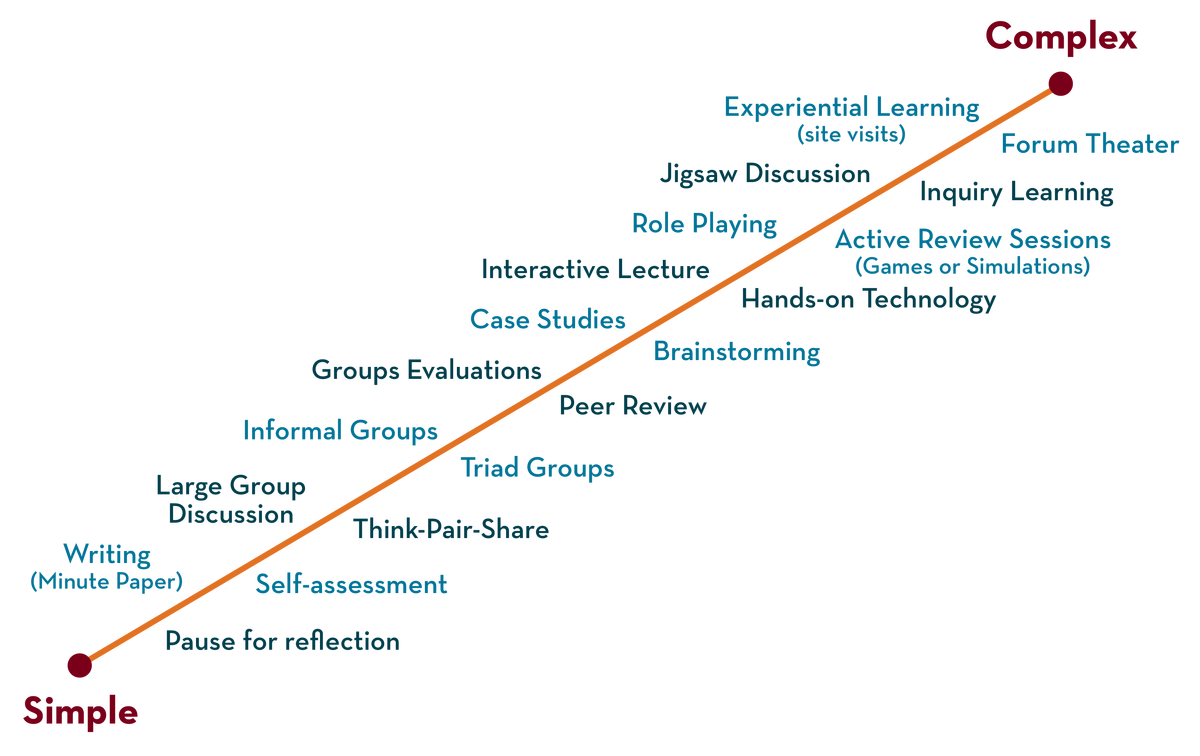
Chart Describing the Examples of Active Learning, Created by the University of Minnesota. Image source.

                                    What is Active Learning?

    “But what is active learning?” You may be asking, dear blog readers. Active learning, as described through research by the University of Minnesota, is a method of teaching in which students, across all grade levels and ages, are encouraged by their teachers to take an active participance in their education, as opposed to more traditional, passive forms of class learning. Active learning can take many shapes and forms, not being limited to any singular style of teaching, class subject or academic discipline, taking the forms of potentially a wide variety of educational strategies and classroom activities. Active learning does not replace traditional classroom setups such as reading, listening to lectures, group projects and students responding to questions when prompted, but rather, active learning is intended to enhance students’ education though teaching them to practice critical and creative thinking, to further develop skills, allow them to discuss material in their own words, learn teamwork with their classmates and to broaden their understanding of the class curriculum and study materials. As described through research by the Cornell University, active learning can benefit students though helping them explore new angles for problem solving; helping students absorb classroom material by talking, writing, and thinking through the lesson plans, form new connections with the material and apply new knowledge to memory through active learning methods and help motivate students to develop new relationships to learning in school beyond simply sitting quietly and listening passively, unengaged with their lessons.   

"A blank sheet of paper equals endless possibilities." - Michael Scott. Image source

                                                       One-Minute Papers

    One example of the many active learning methods teachers can encourage their students to broaden their relationships and understanding with education is through utilizing an active learning method known as One-Minute Papers. One-Minute Papers can be utilized for multiple subjects across different grade levels, benefiting both students and their educators. In class, usually after a topic discussion, class forum, reading, lecture or unit, on any subject matter, the teacher instructs the students to take a piece of paper and pencil or pen, to write down for one minute their thoughts and reflections about what they just learned as a class. This can be helpful in that it encourages students to reflect on what stood out to them in the day's lesson and to voice any questions or observations about their learning experience while the information is still fresh in their minds; while giving the teacher samples of where everyone in class is at with the lesson plan, allowing for both student engagement and feedback at the same time. A benefit of One-Minute Papers is how they are flexible. One-Minute Papers can be arranged to fit the needs of the students, teacher and the subject matter as they are learning new material any given class. It can can ask questions such as “What was the most interesting thing you learned in class today?” Or “What was the most confusing thing in today’s lesson?” These can be written anonymously on blank flashcards if the teacher and class so choose, to be read and reviewed by the teacher at the end of class, followed by a group discussion with students on their opinions on the context of the cards. The One-Minute Papers method of active learning expands upon the concept of note-taking, short writing assignments and end-of-lesson questions with the teacher by turning the talks into something of a game for students. One-Minute Papers, through a creative writing opportunity, allow students to develop their critical thinking skills, while also allowing students the chance to voice their thoughts, questions and concerns at the end of class, becoming engaged with the material on a deeper level through the short-form active learning writing exercises.


                  My Experience with One-Minute Papers

    At this time of writing, I am not a teacher, but a university student studying to earn her master’s degree in Library and Information Science, working to become a public librarian after completing my education. With that said however, in the past, I have volunteered at my church’s Sunday school room, babysitting and helping with the readings and bible studies each week with the grade school children, aged from early elementary to middle-school aged. One of the activities I would help the children with was an exercise similar to the One-Minute Papers, in which I asked the children to write down or draw pictures on blank papers anything which stood out them in the chapters of the lesson plans we just read, or any questions they had, to which I would do my best to answer any questions or comments they had about the reading. This exercise was meant to help the children be engaged with readings and lessons taught in the Sunday school class, encouraging them to reflect and voice their thoughts through writing, arts and craft activities.   

                                             Conclusion

We all should strive to have the confidence of Tina Belcher going to school! Image source. 

    Active learning techniques, such as the One-Minute Papers, are not meant to replace traditional forms of education and curriculums in classrooms, but to be an opportunity for teachers and their students to engage with the material from a new point of view. Active learning, as the name implies, is a chance to spark discussion and motive questions within a class setting. Through experimenting with active learning, students have the opportunity to have their voices heard in their education, a chance to be a proactive participant in learning rather than passively listening. If One-Minute Papers do not suit a class, there are a wide variety of other methods and activities for teachers and students to experience with active learning. Traditional forms of education can be difficult for some students, but with active learning, there are a plethora of ways for students to discover which learning styles, activities and exercises are best suited to their interests and needs, both as individuals and as a classroom.    

LIS 724: Reflecting on EDU 776/LIS 724 Course

                                                Introduction     Hello, readers! It may seem surprising, but the class is already reaching i...