An Introduction
Hello Readers! As someone who is currently an university student, studying to earn her master’s degree in Librarian and Information Science, that means I spend quite a bit of time in classes! Do you remember going to school growing up? Having to sit quietly and listen to the teacher’s lectures, needing to ask permission to speak in the classroom or to move around? I imagine for many students in their early educational journey, their learning experiences in school often felt like being talked down towards and passive, not feeling like you had much of a say in what you learned or what was discussed? Or perhaps, Reader, you are a teacher, and looking for new ways to get your students interested, enriched and engaged in their educational lessons, in ways in which students truly feel that they’re taking an active part in their learning experience rather than a quiet, passive listener? Whether you are a teacher or student, Readers, perhaps you would benefit from active learning in your educational journey?
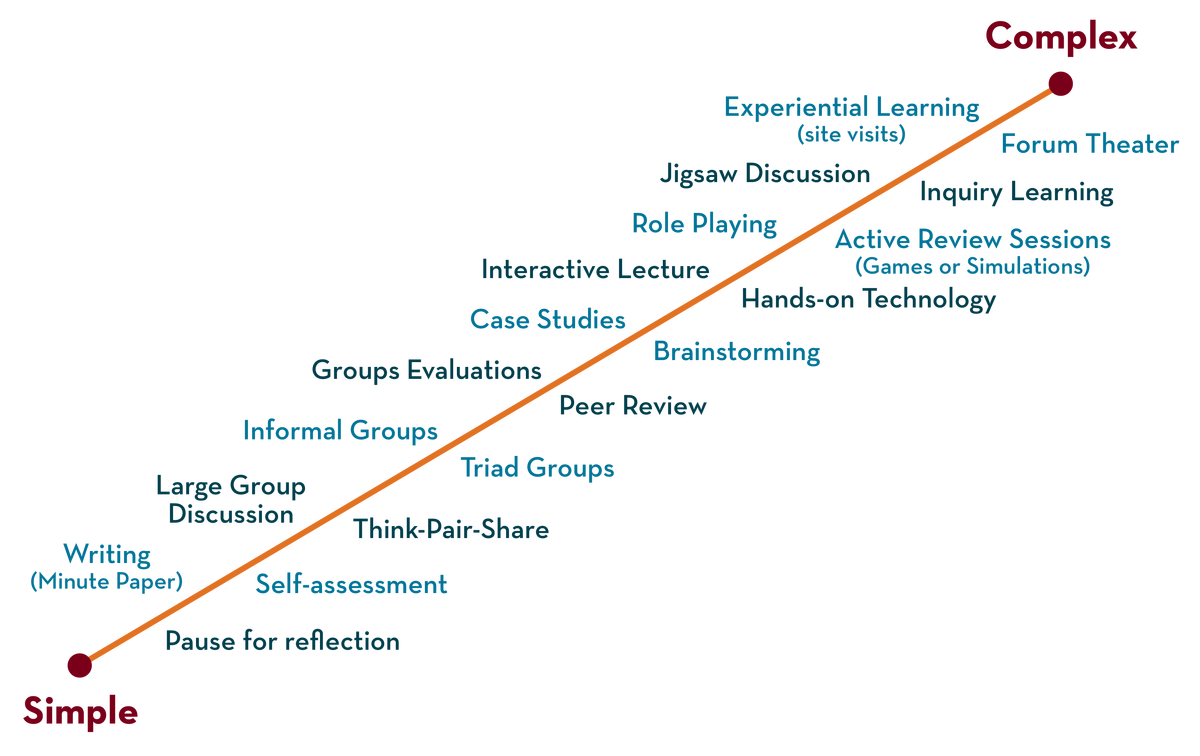 |
| Chart Describing the Examples of Active Learning, Created by the University of Minnesota. Image source. |
What is Active Learning?
“But what is active learning?” You may be asking, dear blog readers. Active
learning, as described through research by the University of Minnesota, is a
method of teaching in which students, across all grade levels and ages, are encouraged
by their teachers to take an active participance in their education, as opposed
to more traditional, passive forms of class learning. Active learning can take
many shapes and forms, not being limited to any singular style of teaching, class subject or
academic discipline, taking the forms of potentially a wide variety of educational
strategies and classroom activities. Active learning does not replace traditional
classroom setups such as reading, listening to lectures, group projects and students responding to questions when prompted, but rather, active learning is intended
to enhance students’ education though teaching them to practice critical and
creative thinking, to further develop skills, allow them to discuss material in
their own words, learn teamwork with their classmates and to broaden their
understanding of the class curriculum and study materials. As described through
research by the Cornell University, active learning can benefit students though
helping them explore new angles for problem solving; helping students absorb
classroom material by talking, writing, and thinking through the lesson plans, form
new connections with the material and apply new knowledge to memory through
active learning methods and help motivate students to develop new relationships
to learning in school beyond simply sitting quietly and listening passively, unengaged with their lessons.
 |
| "A blank sheet of paper equals endless possibilities." - Michael Scott. Image source |
One-Minute Papers
One example of the many active learning methods teachers can encourage their students to broaden their relationships and understanding with education is through utilizing an active learning method known as One-Minute Papers. One-Minute Papers can be utilized for multiple subjects across different grade levels, benefiting both students and their educators. In class, usually after a topic discussion, class forum, reading, lecture or unit, on any subject matter, the teacher instructs the students to take a piece of paper and pencil or pen, to write down for one minute their thoughts and reflections about what they just learned as a class. This can be helpful in that it encourages students to reflect on what stood out to them in the day's lesson and to voice any questions or observations about their learning experience while the information is still fresh in their minds; while giving the teacher samples of where everyone in class is at with the lesson plan, allowing for both student engagement and feedback at the same time. A benefit of One-Minute Papers is how they are flexible. One-Minute Papers can be arranged to fit the needs of the students, teacher and the subject matter as they are learning new material any given class. It can can ask questions such as “What was the most interesting thing you learned in class today?” Or “What was the most confusing thing in today’s lesson?” These can be written anonymously on blank flashcards if the teacher and class so choose, to be read and reviewed by the teacher at the end of class, followed by a group discussion with students on their opinions on the context of the cards. The One-Minute Papers method of active learning expands upon the concept of note-taking, short writing assignments and end-of-lesson questions with the teacher by turning the talks into something of a game for students. One-Minute Papers, through a creative writing opportunity, allow students to develop their critical thinking skills, while also allowing students the chance to voice their thoughts, questions and concerns at the end of class, becoming engaged with the material on a deeper level through the short-form active learning writing exercises.
My Experience with One-Minute Papers
At this time of writing, I am not a teacher, but a university student studying to earn her master’s degree in Library and Information Science, working to become a public librarian after completing my education. With that said however, in the past, I have volunteered at my church’s Sunday school room, babysitting and helping with the readings and bible studies each week with the grade school children, aged from early elementary to middle-school aged. One of the activities I would help the children with was an exercise similar to the One-Minute Papers, in which I asked the children to write down or draw pictures on blank papers anything which stood out them in the chapters of the lesson plans we just read, or any questions they had, to which I would do my best to answer any questions or comments they had about the reading. This exercise was meant to help the children be engaged with readings and lessons taught in the Sunday school class, encouraging them to reflect and voice their thoughts through writing, arts and craft activities.
 |
| We all should strive to have the confidence of Tina Belcher going to school! Image source. |
Active learning techniques, such as the One-Minute Papers, are
not meant to replace traditional forms of education and curriculums in
classrooms, but to be an opportunity for teachers and their students to engage
with the material from a new point of view. Active learning, as the name
implies, is a chance to spark discussion and motive questions within a class
setting. Through experimenting with active learning, students have the opportunity to have their
voices heard in their education, a chance to be a proactive participant in
learning rather than passively listening. If One-Minute Papers do not suit a
class, there are a wide variety of other methods and activities for teachers
and students to experience with active learning. Traditional forms of education can be difficult for
some students, but with active learning, there are a plethora of ways for
students to discover which learning styles, activities and exercises are best suited
to their interests and needs, both as individuals and as a classroom.


I love the memes you have with your post! They really crack me up! The in depth definition that you have written about active learning and how it doesn't replace the things in place to teach in a classroom. But instead, it is an extension to learning. The one minute paper were a perfect example of that!
ReplyDeleteHi Vanessa! Thank you! I know the meme aren't really necessary, but I just they're fun. What's life without a little bit of whimsy? And thank you for your response to my choice for the active learning assignment. The One-Minute Papers reminded me of the worksheets I would help with students while I did volunteer work at my local church, I think they make really great critical thinking and creative writing exercises based on the research I done into them.
DeleteThanks for sharing your experiences with one minute papers, Lizzy. Even if you aren't a teacher, as a student you might recall some of the instruction you participated in- what stood out? Think about some of your courses and assignments you particularly enjoyed- maybe some involved active learning methods.
ReplyDeleteHello Professor Nicole and thank you! I remember that in undergraduate school, my women's literature professor encouraged two forms of active learning, muddiesst point and inquiry learning. She would ask us what points in her lectures or the reading material was the most difficult to understand and then we would discuss the problem as a class and work through it until everyone understood. She would also bring up stories, themes and concepts from our reading material and ask our opinions or observations during lectures as well. It's interesting looking back on my education and realizing how much active learning was used by my teachers while I was growing up.
ReplyDelete