An Introduction
Hello readers, in our modern digital world, technology can advance and change in a relatively short amount of time, with the ways in which people can utilize that technology looking vastly different today from what was commonplace twenty or even ten years ago. In the grand scheme of time, technology has made significant leaps and bounds in advancements in a blink of an eye. Modern tech tools and devices are heavily integrated into various areas of daily life to various degrees, with a key cornerstone of society being the potential applications of technological advancements for educational purposes across differing grade levels and life stages of human development. In present day, technology has evolved to the point where it can have seemingly endless applications for recreational, work and educational possibilities. However, while technological advancements in recent years have transformed educational resources in a wide variety of different shapes and forms, that does not mean that technology is always used to its full potential in school classrooms by teachers and students.
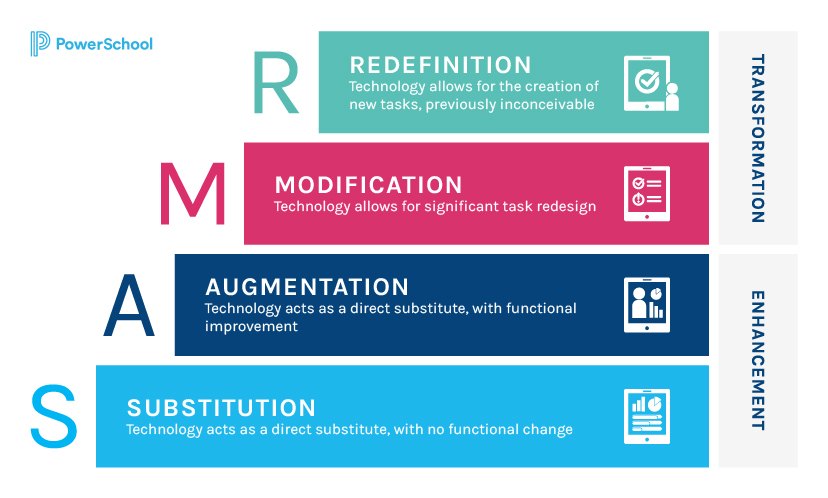
Explaining the SAMR Model
The SAMR Model, which stands for Substitution, Augmentation, Modification, and Redefinition, was developed by Dr. Ruben Puentedura as an
asset in which educators can step back to look at how they and their students
interact with modern software and devices; this model evaluates if they are integrating
technology into their classrooms in an effective manner or to discover the full
potential of their electronic resources. Through comparison and reflection of
the previously stated tiers in the SAMR Model. Each tier highlights an aspect
of modern technology that can utilized for learning that teachers can reflect upon
and review in which ways each of the four levels apply to their classes’ experiences
or be useful moving forward.
Within the hierarchy, Substitution means the replacement of traditional learning material and classroom activities, such as paper, in exchange for electronic counterparts, such as the usage of file-sharing programming such as PDF files, Microsoft software, or Google Drive. The following tier, Augmentation, refers to enhancing the content already in use by the teacher and students, such as though multimedia, adding hyperlinks to written work or utilizing comments through electronic messaging. The third tier is Modification, which refers to transforming the learning methods of a classroom, differing from the previous levels in that it is not replacing or enhancing educational content, but transforming the method of how lesson plans are taught to students, such as the creation of communication channels through means such as Moodle, Canvas or Google Classrooms, made possible with modern digital classroom management software. The fourth and last tier is Redefinition, which means examining and refining how modern technological tools, programs, ecteronic communications devices transform traditional educational methods into brand new learning experiences for students, in ways that would not be possible in prior generations. This can refer to students messaging with classmates or their teacher, or receiving digital feedback on their schoolwork in quicker speeds than without the aid of technology.
 |
| "Topsy!" Image Source |
My Self-Evaluation
At the time of writing, I am not a teacher, nor do I have a background in education, only prior experience babysitting. I am still a graduate student focused on my studies and not employed at the moment, with career plans to work to become a public librarian after completing my education. With that being said, I found the SAMR Model a very useful resource and after reflecting upon my relationship to technology, I found that I am myself someone who primarily uses the first two tiers of the hierarchy, Substitution and Augmentation. I use these two tiers as my schoolwork and prior employment historically focused on making written work digital, the creation of documents and saved files, or the creation of PowerPoints for different projects. I feel that while I am good with the technology I am already familiar with, I know I always have room for improvement. In my future work environment as a public librarian, I want to have learned each of the four levels of the SAMR Model in order to help both patrons and co-workers when needed. I wish to better understand implement the tiers of Augmentation and Modification in particular in order to improve my skillset while helping navigate the computing and database systems of my future public library workplace. Although I am taking a different career path from an teacher, I feel I can still apply what I learn from the SAMR Model into my future goals working in the public library, such as learning how to reflective among the tiers, and evaluate if modern technology is being used to its full potential for the library patrons, such as improving communications, the program calendar, cataloging and database systems, electronic borrowing and the usage of digital material in the library for the improvement of the patrons’ experiences.
Works Cited
Terada, Youki.
“A Powerful Model for Understanding Good Tech Integration.” Edutopia, George Lucas Educational Foundation, 4 May 2020, www.edutopia.org/article/powerful-model-understanding-good-tech-integration.


The SAMR model absolutely can fit into your future library role! At the end of the day, the goal is to make sure we are giving conscious thought about if the technology we are using actually assists us with reaching goals.
ReplyDeleteThank you, Professor Nicole! I was worried at first due to the fact I don't have any experience as a teacher, but I was happily surprised to find ways for the SAMR Model can apply to my chosen future career path, and presumably many other professions across different fields.
ReplyDelete